Official 26 × 32 mm photo
The size Spanish law requires for the DNI and, by extension, for the TIE and the NIE. A 614 × 756 px file at 600 dpi.
Valid for TIE · NIE · DNI · passport · driving licence
Upload a photo taken on your phone and we send it back at the official 26 × 32 mm size, on a plain white background, at true 600 dpi for printing. You see the finished result straight away: if you are not happy with it, upload another photo.
Processing your photo…
0 %
On average, processing takes about 45 seconds.
Worth checking
These are our guesses, not a rejection: we are still processing your photo and you will see it either way.
Your ID photo is ready
The preview carries no watermark: what you see is what you download, at print quality.
The download is free and no payment details are asked for.
Worth checking
These are our guesses, not a rejection: we are still processing your photo and you will see it either way.
We could not use this photo
An ordinary phone photo is fine — JPG, PNG or iPhone HEIC. The background can be anything: a coloured wall, a curtain, a room. No sign-up needed.
We cut out the background and make it plain white, measure the head from the crown to the chin, straighten any tilt and crop to the size the rules require.
You get the single photo plus a 10 × 15 cm sheet with 11 photos and cutting marks, ready to take to any print shop for well under a euro.
The size Spanish law requires for the DNI and, by extension, for the TIE and the NIE. A 614 × 756 px file at 600 dpi.
The classic “carnet” size some gestorías, universities and driving schools still ask for. Included at no extra cost, just in case.
Eleven photos laid out on a standard print-shop sheet, with cutting marks in the margins. Printing it costs cents and leaves you spare copies for other paperwork.
There is no watermark anywhere, neither on the preview nor in the files. You see from the start exactly what you will download, ready to hand in.
The Tarjeta de Identidad de Extranjero has no photo rulebook of its own. The instructions from the Comisaría General de Extranjería y Fronteras point to the requirements for the DNI photo, and those are written down: Royal Decree 1553/2005, article 5.1.b requires “a recent colour photograph of the applicant’s face, 32 by 26 millimetres, with a plain, uniform white background, taken from the front with the head completely uncovered and without dark glasses”.
In practice, this is what gets a photo turned away at the fingerprint appointment: a background with a shadow or a tint, a head too small or too large inside the frame, a turned face, glare on glasses, or a home print on plain paper that looks pixelated. Our processing fixes the first four; for the fifth, we give you the sheet to take to a print shop.
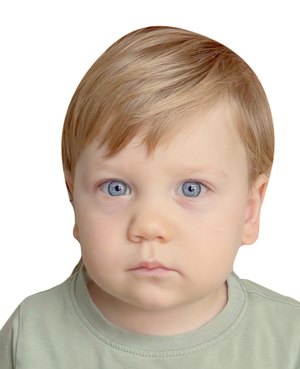
This is the hardest case, and not because of the camera. A newborn is held to exactly the same standard as an adult: eyes open, looking at the lens, mouth closed, head straight and no hands visible holding them up. In a studio this is solved with patience; at home, with a white sheet and thirty photos in a row.
Our practical advice: lay the baby on their back on a plain white cloth — no dummy, no hat, no headband — and shoot from directly above, in window light, with no flash. Pick a moment when they are awake and recently fed. Then send us the best frame: the cropping, the centring and the background are our job.
The file is the same for almost every Spanish procedure, but each one has its own paperwork, its own appointment and its own reasons for rejection. We have split them by document:
What the rule says, the five real reasons photos get rejected and how many copies to take to the fingerprint appointment.
What the DGT asks for, what changed in November 2024 and when a photograph is no longer required.
What to take to the appointment, why bringing your own photo is worth it and how to book a slot at the comisaría.
One is a number, the other a card. Which applies to your case and when a photograph is needed at all.
These are the figures we work to. They are not our interpretation: they come from the DNI regulation, which is also the reference used for the TIE, the NIE and the passport.
| Requirement | Value | Why |
|---|---|---|
| Size | 26 × 32 mm | Royal Decree 1553/2005, art. 5.1.b |
| Head height | 70–80 % of the height (about 23–25 mm) | From the crown, hair included, to the chin |
| Background | Plain, uniform white | No shadows, gradients or objects behind |
| Resolution | 600 dpi (614 × 756 px) | So the print does not come out pixelated |
| Framing | Front-facing, head straight | The eye line must be horizontal |
| Expression | Neutral, mouth closed, eyes open | Biometric systems compare features |
| Accessories | Head uncovered, no sunglasses | Nothing that hinders identification |
| Age of photo | Less than 6 months | It has to look like you today |
A warning about 30 × 40 mm. That is what many people call “passport size”, but it does not appear in the DNI regulation and it has a different aspect ratio. We give you both formats: hand in the 26 × 32 mm one unless you are specifically asked for the other.
The processing corrects the background, the framing, the tilt and the colour, but it cannot invent what is not in the photo. These five points are what separate a result that works from one you have to retake:
What we deliberately do not do. We do not retouch features, slim faces, generate pixels with generative AI or “invent” resolution. A document is compared against your real face: any extra retouching is grounds for rejection. What we do is crop, measure, straighten and adjust tone with pixel precision.
Your download includes a 10 × 15 cm sheet with eleven photos already laid out and cutting marks in the margins. It is the standard format of any print machine — Fotoprix, Carrefour, El Corte Inglés, a local locutorio — and usually costs between €0.20 and €0.60.
The sentence to say at the shop: “print at actual size, 100 %, without fitting to the page and without automatic borderless”. When a machine prints “borderless” it stretches the image by 2–3 % and the photos stop measuring 26 × 32 mm.
You can also print it at home on photo paper, with the same condition: 100 % scale, never “fit to page”. Plain paper will not do — the ink bleeds and grey comes out grey.
At a photo shop
€8 – 14
You have to go, wait your turn and accept whatever comes out. Retaking it usually costs the same as the first time.
Here
free
From your sofa, with the photo you choose, seeing the finished result straight away. No sign-up, no subscription and nothing to pay.
Photo booth
€5 – 7
Cheap, but the light is harsh, the framing is fixed and there is no second chance if you blink.
Yes. The TIE refers to the DNI photo requirements, and that is exactly what we produce: 26 × 32 mm, colour, plain white background, front-facing, head uncovered. Take two printed copies to the appointment, in case the comisaría keeps one.
The Spanish DNI and passport use the same 26 × 32 mm photo. For the driving licence, the Dirección General de Tráfico asks for 32 × 26 mm at in-person appointments, so it fits too. If you are asked for 30 × 40 mm, that file is included in the download.
Technically yes, if the face is large and front-facing. Legally it is unwise: the rules ask for a photo from the last six months. And if the head is under 544 pixels tall in the original, the system rejects it, because reaching 600 dpi would mean enlarging it and it would look blurry on paper.
Write to hola@fotocarnet.es and tell us why. If the fault is in our processing, we refund you. What we cannot fix is what was already in the original photo: a gaze off to the side, a turned head or closed eyes cannot be corrected without retaking the shot.
They delete themselves after 24 hours — both the one you upload and the result. There are no user accounts, we do not share images with third parties and they are not used to train models. More detail in the privacy policy.
Nothing. You upload the photo, we process it and show you the finished result with no watermark on it, exactly as you will download it. We never ask for payment details.
Yes, upload them as they are, no conversion needed. We also accept JPG and PNG.
Upload the photo, look at the result and decide afterwards. Free, no sign-up.
Start now